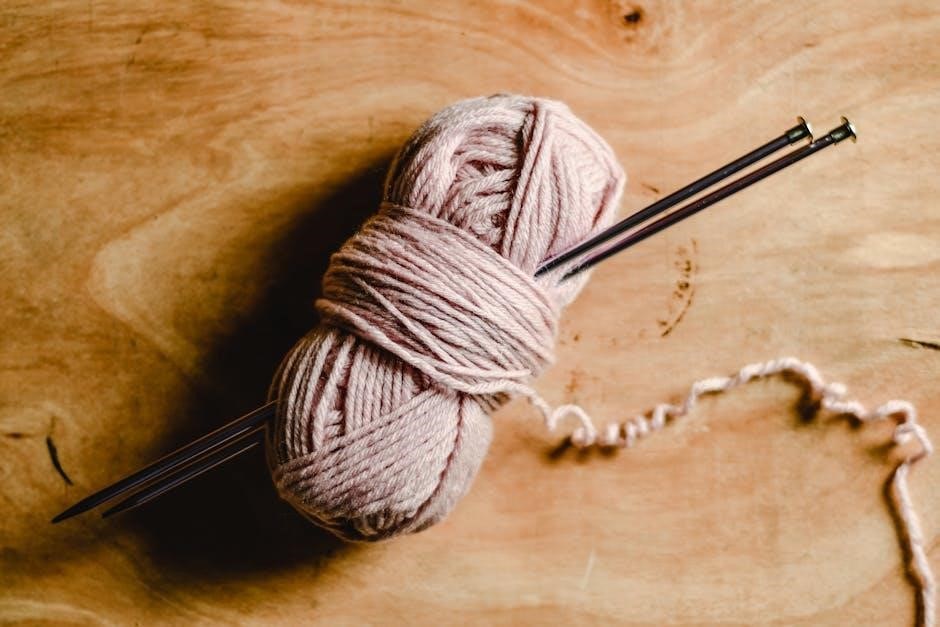
Knitting patterns frequently utilize shorthand, making a free printable PDF chart invaluable for quick reference during projects. These charts simplify complex instructions!
Understanding these abbreviations saves time and reduces frustration, allowing knitters to focus on enjoying the craft, as seen in resources like “I Like Knitting”.
Why Understanding Abbreviations is Crucial
Knitting abbreviations are essential because patterns are often concisely written, assuming a base level of knowledge. Without deciphering these codes – like “k2tog” or “YO” – a knitter faces significant roadblocks, hindering project completion and enjoyment. A knitting abbreviations PDF acts as a vital key, unlocking the pattern’s instructions.
These shortcuts aren’t merely for brevity; they streamline the writing process for designers and prevent lengthy, repetitive instructions. A readily available chart, downloadable as a free PDF, eliminates constant interruptions to look up terms. This uninterrupted flow fosters a more relaxing and productive knitting experience.
Furthermore, consistent understanding across patterns is paramount. A standardized set of abbreviations ensures knitters can seamlessly transition between designs, regardless of the source. Resources like those found online and in publications offer this standardization, making a PDF guide incredibly useful.
The History of Knitting Abbreviations
The evolution of knitting abbreviations mirrors the craft’s own history. Early knitting instructions were often entirely written out, becoming cumbersome as patterns grew in complexity; As knitting became more widespread, a need for concise communication arose, leading to the gradual adoption of shorthand.
Initially, these were likely informal, varying by region and knitter. However, with the rise of published patterns in the 19th and 20th centuries, standardization began. Publications and knitting guilds played a role in establishing common abbreviations. The need for a quick reference, like a knitting abbreviations PDF, grew alongside this standardization.
Today, a free PDF chart is a modern extension of this historical trend – a readily accessible tool for navigating the language of knitting. The continued use and refinement of these shortcuts demonstrate their enduring value to the knitting community.

Basic Knitting Abbreviations
Essential abbreviations like ‘K’ for knit and ‘P’ for purl form the foundation of most patterns; a PDF chart quickly clarifies these basics!
Understanding ‘CO’ (cast on) and ‘BO’ (bind off) is crucial, often found clearly defined within a printable PDF.
Knit (K) and Purl (P)
Knit (K) and Purl (P) are the two fundamental stitches in knitting, forming the basis of countless patterns. Mastering these is paramount for any knitter, beginner or experienced.
The ‘K’ abbreviation signifies inserting the needle into the front of the stitch and drawing the yarn through, creating a ‘V’ shape. Conversely, ‘P’ indicates inserting the needle from the right side, wrapping the yarn, and pulling it through to form a horizontal ridge.
A knitting abbreviations PDF will invariably highlight these as the most basic commands. Many resources, like those found online, offer visual aids alongside the abbreviations, making learning easier. Recognizing these stitches quickly, without constant reference, is key to smooth, enjoyable knitting. A well-organized PDF chart is an invaluable tool for this!
These stitches, when combined and repeated, create a vast array of textures and designs.
Cast On (CO) and Bind Off (BO)
Cast On (CO) and Bind Off (BO) are the essential beginning and ending techniques in knitting, framing your work. ‘CO’ refers to creating the initial stitches on your needle, forming the foundation row. Numerous methods exist, but the long-tail cast on is a popular choice.
Conversely, ‘BO’ secures the stitches, preventing unraveling, and finishing your project. A simple bind-off involves knitting or purling two stitches together, then passing the first stitch over the second.
Any comprehensive knitting abbreviations PDF will clearly define these terms. These are often the first instructions encountered in a pattern, making their understanding crucial. A printable chart simplifies remembering these steps, especially for beginners. Mastering CO and BO ensures a neat and professional finish to every knitted item.
These techniques, though seemingly simple, are foundational to successful knitting.
Common Increase and Decrease Abbreviations
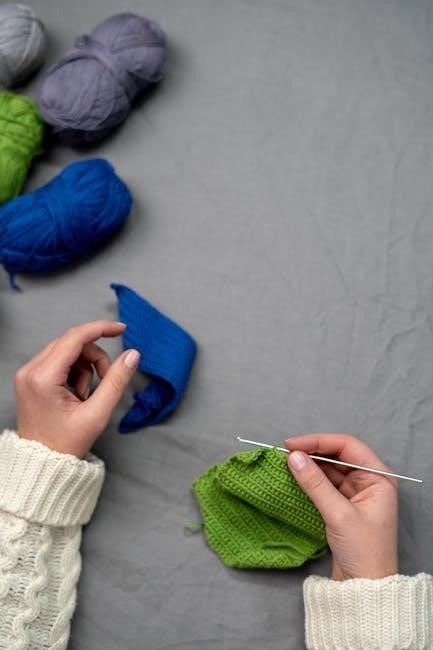
Increase and decrease abbreviations, like M1, K2tog, and P2tog, shape your knitting. A PDF chart provides a quick reference for these essential techniques!
Make One (M1) – Left and Right
Make One (M1) is a fundamental increase technique, creating a new stitch. A knitting abbreviations PDF will clearly illustrate both left-leaning (M1L) and right-leaning (M1R) variations.
M1L involves lifting the bar between stitches from the back to the front, then knitting into the front of that lifted bar. Conversely, M1R lifts the bar from the front to the back, knitting into the back of the lifted bar.
These subtle differences affect the fabric’s appearance; M1L creates a left-slanting increase, while M1R creates a right-slanting increase. Utilizing a PDF chart ensures correct execution, preventing unwanted holes or distortions. Mastering M1L and M1R expands your shaping options, allowing for intricate designs and well-fitted garments. Remember to consult your pattern for specific M1 instructions!
Knit Two Together (K2tog)
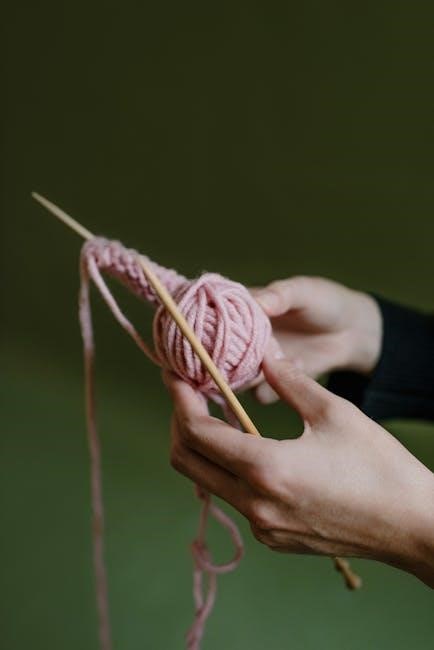
Knit Two Together (K2tog) is a common decrease abbreviation, essential for shaping knitted fabric. A comprehensive knitting abbreviations PDF will visually demonstrate this technique, ensuring accuracy;
To execute K2tog, insert the right needle into two stitches simultaneously, as if to knit them together. Then, knit these two stitches as one, effectively reducing the stitch count by one. This creates a right-leaning decrease, subtly shaping the work.
Consistent K2tog execution is crucial for maintaining pattern integrity. A PDF chart provides a quick reference, preventing accidental increases or uneven shaping. Mastering K2tog unlocks a wide range of design possibilities, from fitted sweaters to elegant accessories. Always double-check your work to ensure a clean, professional finish!
Purl Two Together (P2tog)
Purl Two Together (P2tog) is a fundamental decrease technique, mirroring K2tog but utilizing the purl stitch. A detailed knitting abbreviations PDF is invaluable for visualizing and mastering this skill, especially for beginners.
To perform P2tog, insert the right needle into two stitches as if to purl them together. Then, purl these two stitches as one, decreasing the stitch count by one. This creates a left-leaning decrease, offering a contrasting shape to K2tog.
Like K2tog, consistent P2tog execution is vital for pattern accuracy. A readily available PDF chart serves as a quick reference, minimizing errors. Utilizing both K2tog and P2tog allows for complex shaping and intricate designs. Practice makes perfect – ensuring neat, even decreases enhances the overall quality of your knitted projects!
More Advanced Knitting Abbreviations

Advanced techniques like yarn overs and slip stitches require precise execution; a comprehensive knitting abbreviations PDF clarifies these complex instructions for seamless projects.
Yarn Over (YO)
Yarn Over (YO) is a fundamental technique creating intentional holes in your knitted fabric, often used for lace patterns or decorative elements. A knitting abbreviations PDF will clearly illustrate how to execute this maneuver, typically involving bringing the yarn forward between the needles.
This action increases the stitch count on the next row. Understanding YO is crucial as it’s frequently found in more intricate patterns. The PDF resource will demonstrate how the yarn is wrapped, creating the eyelet. It’s important to note that the YO is usually worked in conjunction with other stitches, like a knit or purl stitch, to secure the created hole.
Proper execution ensures a clean and defined look. Many patterns will specify whether to work the YO as a yarn over front (YOF) or yarn over back (YOB), impacting the appearance of the resulting hole. A good abbreviations PDF will detail these nuances.
Slip Stitch (sl)
Slip Stitch (sl), as detailed in a comprehensive knitting abbreviations PDF, involves transferring a stitch from the left to the right needle without working it. This technique is versatile, used for creating textured patterns, edges, or colorwork effects. The PDF will visually demonstrate slipping with or without yarn, impacting the fabric’s appearance.
Slipping stitches can create a firmer edge, preventing curling, or add subtle visual interest. Different variations exist – slip stitch with yarn held to the front or back – each producing a unique texture. A clear abbreviations PDF will explain these distinctions.
Understanding ‘sl’ is vital for following complex patterns. It’s often used in combination with other stitches, requiring precise execution. The PDF resource will clarify how slipped stitches affect the stitch count and overall fabric structure, ensuring accurate pattern replication.
Slip, Slip, Knit (SSK)
Slip, Slip, Knit (SSK) is a common decrease technique, thoroughly explained within a detailed knitting abbreviations PDF. This method creates a left-leaning decrease, subtly shaping your knitted fabric. The PDF will illustrate how to slip two stitches knitwise, one at a time, then knit them together through the back loops.
SSK results in a decrease that’s less noticeable than a standard knit two together (K2tog), offering a smoother, more refined finish. A good abbreviations PDF will highlight the difference in appearance and usage between SSK and K2tog.
Mastering SSK is crucial for shaping garments and accessories. The PDF resource will provide step-by-step instructions and potentially include diagrams, ensuring accurate execution and a professional-looking result. It’s a fundamental skill for intermediate knitters.
Abbreviations Related to Pattern Structure
Knitting abbreviations PDF guides clarify structural terms like “Rep” (repeat) and “Alt” (alternate), essential for following complex pattern instructions efficiently.
Repeat (Rep)
The abbreviation “Rep” stands for “repeat,” and it’s arguably one of the most frequently encountered terms within knitting patterns. A knitting abbreviations PDF will clearly define this, highlighting its importance in creating patterned fabrics. When you see “Rep from * to ,” for example, it means you should continuously work the instructions between the asterisks.
This repetition creates motifs, ribbing, or any design element within the knitted piece. The pattern will often specify how many* times to repeat a section. Understanding “Rep” is crucial because misinterpreting it can drastically alter the final outcome of your project. A well-organized PDF chart will visually demonstrate how to execute these repetitions, making complex patterns more accessible.
Essentially, “Rep” is the building block of many knitted designs, and mastering its interpretation, aided by a handy abbreviations PDF, unlocks a world of creative possibilities!
Alternate (Alt)
The knitting abbreviation “Alt” signifies “alternate,” indicating a choice between two or more instructions within a pattern. A comprehensive knitting abbreviations PDF will clearly explain this, often providing examples for clarity. You’ll typically encounter “Alt” when a pattern offers variations, such as different stitch patterns or colorwork options.
For instance, a pattern might state “Rows 1-4: Alt K1, P1” meaning you’ll knit one row, then purl the next, and repeat this sequence. A PDF chart can visually represent these alternating rows, simplifying the process. Understanding “Alt” allows for customization and personalization of your knitted projects.
Properly interpreting “Alt,” with the help of a reliable abbreviations PDF, ensures you achieve the desired look and feel of your finished piece, embracing the flexibility knitting offers!
Resources for Knitting Abbreviations
Free printable PDF charts and online knitting abbreviation dictionaries are readily available, simplifying pattern reading and boosting confidence for knitters of all levels.
Free Printable PDF Charts
Knitting abbreviation charts in PDF format are incredibly useful tools for both beginner and experienced knitters. These downloadable resources consolidate common shorthand notations into a single, easily accessible document, eliminating the need to constantly search online while mid-project.
Many websites offer these free charts, such as “I Like Knitting” with their “Master Abbreviations Chart,” designed to save knitters time and reduce frustration. Having a physical copy nearby allows for quick reference, especially when encountering unfamiliar terms or symbols within a pattern.
These PDFs often categorize abbreviations by type – basic stitches, increases, decreases, and pattern structure – making it even easier to locate the definition you need. They are perfect for keeping in your knitting bag or alongside your pattern, ensuring a smooth and enjoyable knitting experience. Downloadable charts truly enhance the knitting process!
Online Knitting Abbreviation Dictionaries
Beyond printable PDF charts, numerous online knitting abbreviation dictionaries provide comprehensive lists of terms and their definitions. These digital resources are accessible from any device with an internet connection, offering convenience and a vast amount of information at your fingertips.
Websites dedicated to knitting often host these dictionaries, allowing knitters to quickly decipher unfamiliar abbreviations encountered in patterns. These resources frequently include detailed explanations, and sometimes even visual aids, to clarify the meaning of each term.
While PDFs offer portability, online dictionaries excel in searchability and often contain a wider range of less common abbreviations. They are invaluable tools for expanding your knitting vocabulary and confidently tackling complex patterns, ensuring a smoother and more enjoyable crafting experience.

Knitting Communities and Abbreviations
Knitting communities often share PDF abbreviation guides, fostering collaboration and understanding. Even groups like AFOL appreciate detailed instructions and clear terminology!
AFOL (Adult Fans of Lego) ⎯ Relevance to Detailed Instructions
Adult Fans of Lego (AFOLs), while seemingly unrelated to knitting, demonstrate a key principle: the appreciation for precise, detailed instructions. Just as complex Lego builds require understanding specific brick codes and building techniques, knitting relies heavily on a standardized system of abbreviations.
Both hobbies demand deciphering a unique language. AFOLs need to interpret building manuals, while knitters navigate patterns filled with shorthand like ‘K2tog’ or ‘YO’. The availability of a knitting abbreviations PDF is akin to a Lego parts list – it ensures clarity and prevents errors.
This parallel highlights why clear communication is vital in any craft. A well-organized PDF chart, readily accessible, empowers both the Lego enthusiast and the knitter to successfully complete their projects, fostering enjoyment and a sense of accomplishment.
Be First to Comment